
Cost Segregation Benefits
Published: February 3, 2026 | Updated: February 19, 2026
Cost segregation is an engineering based method that identifies building components and certain land improvements that may qualify for shorter depreciation lives than the building shell.
For investors, cost segregation benefits are best understood as a tax timing strategy. By shifting deductions earlier, cost segregation benefits can improve after tax cash flow and increase the amount of capital available for reinvestment. Results vary and depend on your facts and tax position.
TL;DR – Key Takeaway
What Are Cost Segregation Benefits?
Cost segregation benefits describe the financial outcomes that can follow when an owner reclassifies parts of a building into shorter depreciation lives. In practical terms, cost segregation benefits usually mean earlier depreciation deductions compared to standard depreciation.
The benefits of cost segregation are not magic and they do not create new deductions out of thin air. Most benefits of a cost segregation are timing benefits. Deductions that would have been spread over decades are moved earlier, which can improve cash flow if you can use the deductions.
The most important cost segregation benefits are financial and operational, not just tax terminology. Investors care about after tax cash flow, reinvestment capacity, and the quality of documentation that supports the position.
How Cost Segregation Creates Tax Benefits
Cost segregation creates tax benefits by changing the depreciation life of certain components. Instead of depreciating everything as 27.5 year residential rental property or 39 year nonresidential real property, eligible components may fall into shorter categories such as 5, 7, or 15 years.
These cost segregation tax benefits come from how the tax code treats different asset classes. Personal property and certain land improvements can have shorter lives. A properly prepared cost segregation study documents what qualifies and why.
Bonus depreciation can amplify cost segregation study benefits when it applies to the reclassified components. The applicable bonus percentage and rules depend on the placed in service year, and changes in law can affect future years. Your CPA should confirm how current rules apply to your facts.
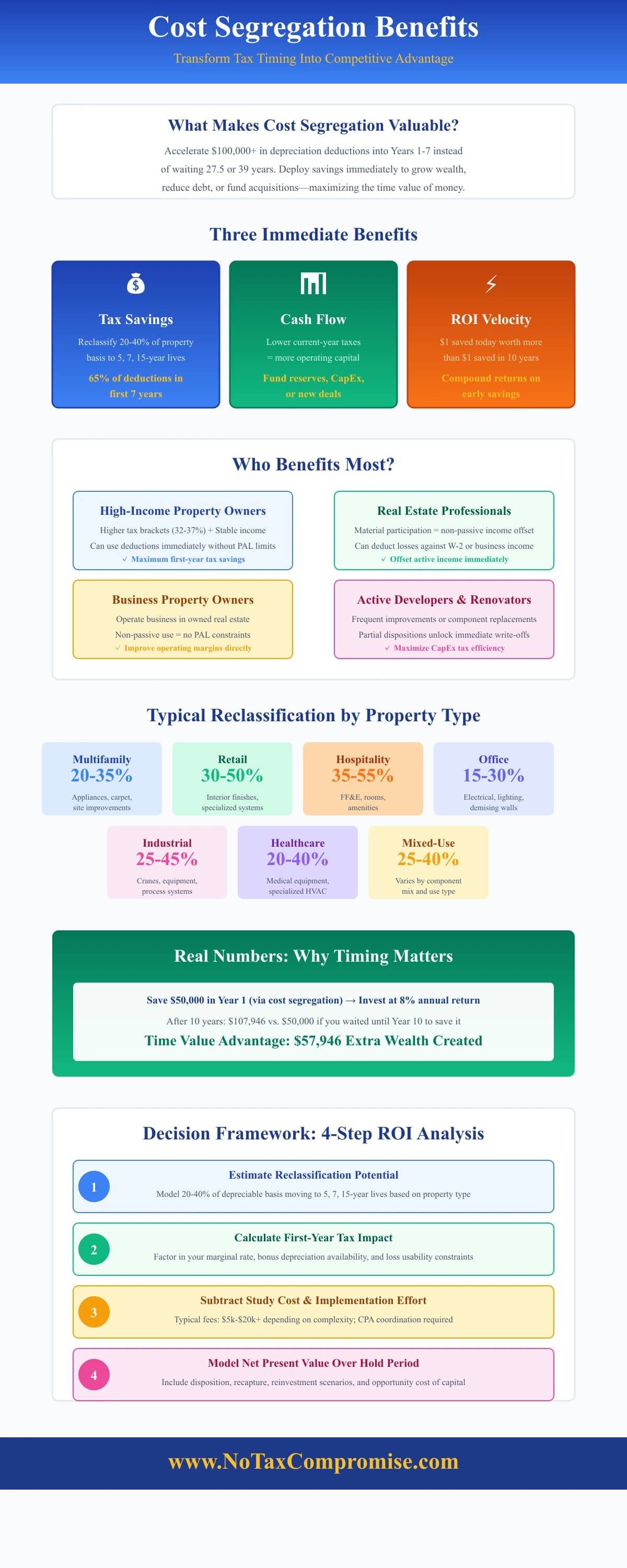
Primary Financial Benefits of Cost Segregation
The primary financial cost segregation benefits typically fall into a few buckets: acceleration of deductions, improved after tax cash flow, and improved capital allocation decisions. These benefits of cost segregation matter most when they change what you can do with your capital in the early years of ownership.
Table 1: Benefit Type vs Financial Impact vs Timing
| Benefit Type | Financial Impact | Timing |
|---|---|---|
| Accelerated depreciation deductions | Higher deductions earlier can reduce current taxable income. | Immediate to near term |
| Bonus depreciation leverage (when available) | Larger first year deductions on eligible components. | Immediate (rule dependent) |
| Better after tax cash flow | More cash retained can fund reserves, debt paydown, or acquisitions. | Near term |
| Improved capital planning | Better projections can inform hold period and renovation timing. | Ongoing |
| Disposition and component tracking | Can support partial dispositions and more precise tax reporting. | Mid to long term |
Cash Flow and Reinvestment Advantages
Many investors pursue cost segregation benefits for the reinvestment effect. If cost segregation benefits reduce current tax liability, that cash can be redeployed into reserves, renovations, debt reduction, or new acquisitions. The benefit is not only the deduction. It is the optionality created by better near term cash flow.
The benefits of a cost segregation are strongest when the owner can use the deduction and has a productive use for the cash. If you cannot use the deduction due to passive activity limits or low taxable income, cost segregation benefits may still exist but may be delayed until the losses can be used.
Investors often model cost segregation study benefits as part of a broader capital stack plan. That includes expected renovation schedules, refinance timing, and disposition scenarios. The cost segregation tax benefits should fit into that plan, not drive it blindly.
Who Benefits Most From Cost Segregation
The biggest cost segregation benefits tend to show up for owners with substantial depreciable basis and the ability to use the deductions. In other words, cost segregation benefits are not just about the property. They are also about the taxpayer.
Investor profiles that often see meaningful cost segregation benefits
- Owners with stable taxable income and higher marginal tax rates where accelerated deductions can offset current tax liability.
- Businesses that own or improve real property and can implement depreciation changes through their tax preparer.
- Investors who understand passive activity rules and can use losses or plan when losses will be released.
- Owners planning major renovations, where component level tracking can support more accurate reporting.
Owners who benefit least from cost segregation benefits are often those with limited taxable income, unclear ownership records, or an inability to use the accelerated depreciation due to their tax situation. This is why cost segregation benefits should be evaluated with your CPA in context.
Cost Segregation Benefits by Property Type
Cost segregation benefits by property type vary because different property types have different mixes of eligible components. Interior build outs, specialized electrical, site improvements, and equipment can change the portion of basis eligible for shorter lives. A cost segregation study benefits analysis should not assume a single number applies to every building.
Table 2: Property Type vs Typical Benefit Level vs Notes
| Property Type | Typical Benefit Level | Notes |
|---|---|---|
| Industrial and manufacturing | High | Specialized electrical and site work can increase eligible components. |
| Hospitality | High | Furniture, fixtures, and certain amenity components can be significant. |
| Retail | Medium to High | Tenant improvements and parking lots often matter. |
| Office | Medium | Build out quality and specialized systems drive variation. |
| Warehouses and logistics | Medium | Site improvements and specialized equipment can move the needle. |
| Multifamily | Medium | Common areas, amenities, and site work are frequent drivers. |
Short-Term vs Long-Term Benefits
Short term cost segregation benefits are usually the most visible. Accelerated depreciation and potential bonus depreciation can produce larger deductions early in ownership. That can improve near term cash flow, which is why many investors focus on short term benefits of cost segregation.
Long term cost segregation benefits are more nuanced. Because cost segregation benefits often accelerate deductions, later year depreciation can be lower. On sale, there may be depreciation recapture considerations, and tax rates can change. For this reason, a long term view should model disposition, refinancing, and holding period assumptions.
A useful way to evaluate cost segregation benefits across time is to separate the accounting benefit from the economic benefit. The economic benefit comes from the time value of money and reinvestment, not from the label on the depreciation schedule.
Cost Segregation vs Standard Depreciation
Under standard depreciation, most of the building basis is depreciated over 27.5 or 39 years. Cost segregation benefits come from identifying shorter life property components, which changes the timing of deductions.
A simple comparison
- Standard depreciation: Most basis follows the building life with less front loading.
- Cost segregation: Some basis shifts into 5, 7, or 15 year classes, potentially increasing early year deductions.
Cost segregation study benefits are stronger when the property has a meaningful portion of eligible components and when the owner can use the deductions. Without either, the benefits of a cost segregation may be smaller or delayed.
How Benefits Connect to ROI
Cost segregation benefits connect to ROI through cash flow timing. The study has a cost, and the benefits of cost segregation produce earlier tax savings relative to standard depreciation. ROI evaluates whether the expected cash flow improvement exceeds the cost, adjusted for timing and risk.
For a detailed framework, see Cost Segregation Return on Investment (ROI). That page explains how cost segregation ROI is calculated, typical ranges, and the assumptions that matter.
A practical investor approach is to ask: If cost segregation benefits accelerate a certain range of deductions this year, what is the after tax cash flow impact at my marginal rate, and how does that compare to the study fee? Then model the downside if assumptions change. This keeps cost segregation benefits grounded in decision making.
Frequently Asked Questions
What are cost segregation benefits in one sentence?
Cost segregation benefits are mainly timing benefits that accelerate depreciation deductions into earlier years, which can improve near term cash flow for eligible property owners.
Are cost segregation tax benefits permanent or temporary?
Most cost segregation tax benefits are temporary timing benefits because they accelerate deductions rather than creating new deductions. The long term result can change based on recapture, tax rates, and the disposition strategy.
Who gets the most cost segregation benefits?
Owners with taxable income, higher marginal tax rates, and substantial depreciable basis tend to see the most cost segregation benefits. Real estate investors who can use the deductions under passive activity rules often benefit more.
Does bonus depreciation increase the benefits of cost segregation?
Yes, bonus depreciation can increase the benefits of cost segregation by allowing more of the reclassified components to be deducted sooner. The impact depends on the placed in service year and current tax rules.
What are the downsides of a cost segregation study?
Downsides can include study cost, added documentation requirements, and potential complexity for your tax preparer. Results vary and there can be recapture considerations when you sell or dispose of components.
Does cost segregation increase audit risk?
Cost segregation itself does not automatically increase audit risk, but aggressive positions and poor documentation can. A well documented, engineering supported study aligned with IRS guidance can help reduce defensibility risk.
When do cost segregation benefits show up?
Cost segregation benefits typically show up in the tax year the property is placed in service or the year a change in accounting method is filed. The timing depends on how the study is implemented by your CPA.
How do cost segregation benefits connect to cost segregation ROI?
Cost segregation benefits drive cost segregation ROI through earlier deductions that can improve after tax cash flow relative to the study fee. For a step by step ROI framework, see the ROI pillar page.