
How Cost Segregation Works: Step-by-Step Process
Published: February 8, 2026 | Updated: February 12, 2026
How does cost segregation work in practice starts with defining the property, the basis you are depreciating, and the tax year you are implementing. A provider collects cost detail, drawings, and property evidence, then performs a site review or document based engineering analysis. Components are classified into recovery periods and methods, and the results are modeled against current depreciation schedules. The process only creates value when the implementation is carried through accurately on the return.
Investors should treat the workflow as a controlled project with clear inputs, review gates, and reconciliation checkpoints. The largest timeline risk is missing cost detail, unclear capitalization policies, or late CPA review. A clean report ties each reclassification to evidence and to the final basis rollup. This page walks through each phase so you know what to request and how to avoid rework.
TL;DR - Key Takeaway
Process Overview
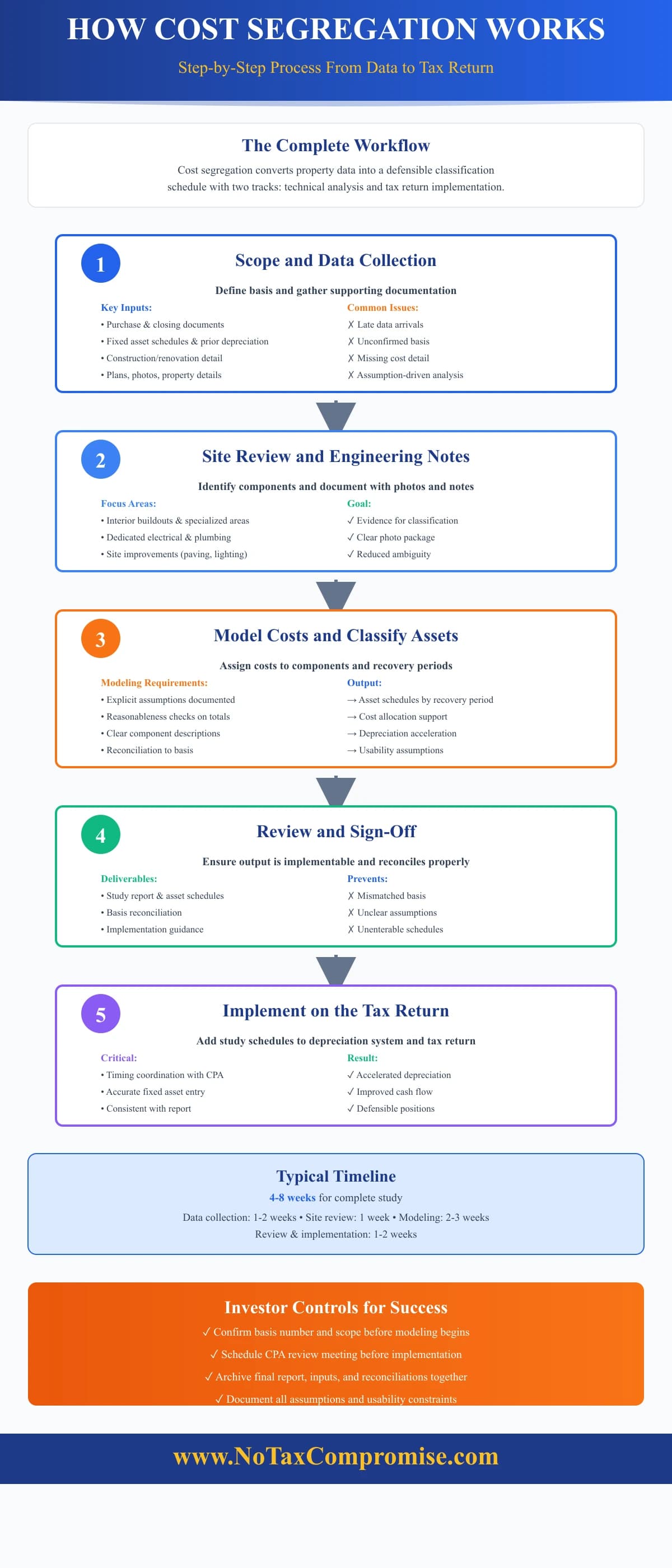
Investors ask how does cost segregation work because the output looks like a simple schedule. In practice, how does cost segregation work is a workflow that converts property facts and cost data into a defensible classification and an implementable depreciation schedule.
The cost segregation process has two tracks that must stay aligned: technical classification and tax return implementation. If you want a conceptual overview before the steps, use the cost segregation hub. This page focuses on how does cost segregation work step by step.
Step 1: Scope and Data Collection
Step 1 in how does cost segregation work is defining the scope and collecting inputs. You confirm the basis you intend to analyze, what costs are included, and what documents exist to support allocations.
Typical inputs
- Purchase and closing documents for acquisitions.
- Fixed asset schedules and prior depreciation if already placed in service.
- Construction or renovation detail when available.
- Plans, photos, and property details that support component identification.
Table 1: Inputs by Source and What They Support
| Input | Source | Supports |
|---|---|---|
| Basis schedule | CPA, acquisition model | Reconciliation and starting scope |
| Invoices and budgets | Owner, contractor, lender | Component cost support |
| Plans and photos | Owner records, site review | Component identification and evidence |
Most execution problems in cost segregation study how it works start here. If data arrives late or basis is not confirmed, the analysis becomes assumption driven and harder to implement.
Step 2: Site Review and Engineering Notes
Step 2 in how does cost segregation work is the site review. The goal is to identify components that may qualify as shorter life property and to document them with photos and notes.
Common focus areas
- Interior buildouts and specialized areas that differ from the base shell.
- Dedicated electrical and plumbing tied to specific functions.
- Site improvements such as paving, lighting, and exterior fixtures.
Step by step cost segregation is not only identification. It is evidence. A clean photo package with clear notes reduces ambiguity in later classification and cost modeling.
Step 3: Model Costs and Classify Assets
Step 3 is the modeling phase, where the team builds a cost segregation analysis that assigns costs to components and recovery periods. This is the most technical part of how does cost segregation work. The schedules must also reconcile to the basis used for depreciation.
Modeling requirements
- Explicit assumptions when cost detail is incomplete.
- Reasonableness checks on major categories and totals.
- Clear component descriptions that map to real property elements.
Investors often care about how cost segregation saves taxes. The correct answer is that it accelerates depreciation when deductions are usable. This step is where usability assumptions should be documented, not implied.
Step 4: Review and Sign-Off
Step 4 ensures the output can be implemented. In mature workflows, how does cost segregation work includes review meetings, reconciliation review, and a sign-off process that aligns the provider report with CPA implementation.
Table 2: Deliverables and Responsibilities
| Deliverable | Prepared By | Reviewed By |
|---|---|---|
| Study report and asset schedules | Provider | Investor team and CPA |
| Basis reconciliation | Provider | CPA |
| Tax return implementation | CPA | Investor |
A review step prevents common failures such as mismatched basis, unclear assumptions, and schedules that cannot be entered into a fixed asset system.
Step 5: Implement on the Tax Return
Step 5 is implementing the results. A complete answer to how does cost segregation work includes how the study schedules are added to the depreciation system and reflected on the tax return for the relevant year.
This step is where timing and coordination with your CPA matters. A strong report that is implemented incorrectly can produce an incorrect return or an inconsistent fixed asset schedule.
If you want to see how the same workflow shows up in practical scenarios, review cost segregation examples. Examples make how does cost segregation work easier to visualize.
Timing and Controls
A reliable workflow includes controls. Without controls, investors can end up with a report that does not reconcile, does not match the basis used on the return, or does not align with the implementation approach.
Practical controls for investors
- Confirm the basis number and scope before modeling begins.
- Schedule a CPA review meeting before implementation.
- Archive the final report, inputs, and reconciliations together.
The next question after learning how does cost segregation work is whether the property has enough eligible components. The next article addresses what assets qualify for cost segregation.
Frequently Asked Questions
How does cost segregation work at a high level?
How does cost segregation work can be summarized as: scope and collect data, document the property, identify and quantify components, classify them into recovery periods, then implement the schedules on the tax return.
Who should be involved in the process?
A provider typically prepares the study, and the CPA typically implements it on the return. The investor should confirm basis, provide data, and review assumptions, timing, and implementation details.
How does cost segregation work if cost detail is incomplete?
Teams may use engineering estimation methods and cost databases when invoices are missing. The key is that assumptions are explicit and totals reconcile to the basis used for depreciation.
What is the single most important control step for investors?
Confirm the basis number and what is included in scope before modeling begins. Many issues trace back to a basis mismatch between the report and the depreciation schedule used on the return.
How does cost segregation work with renovations?
Renovations add a tracking problem. You must separate acquisition basis from improvement basis, track placed in service timing for improvement phases, and coordinate how assets are set up in the depreciation system.
How long does a cost segregation study take?
Timing depends on property size, complexity, and data readiness. Investors often align the timeline with filing deadlines and CPA review cycles to avoid rushed implementation.
What makes implementation fail even when the report is good?
Implementation failures often come from missed communication with the CPA, unclear basis reconciliation, or setting up assets incorrectly in the depreciation system, which can produce inconsistencies on the tax return.
How should investors store and maintain records?
Keep the final report, source documents, reconciliations, and assumption notes together. Durable record keeping supports tax preparation and improves defensibility if the work is reviewed later.